
Most Companies Don't Have a Hiring Process. They Have Habits.
Most companies think their hiring process works. Until someone walks out the door six months after they walked in.
Usually, the problem isn't the person. It's the process.
Or more accurately, the lack of one.
Many organizations still rely on instinct, inconsistent interviews, and loose stakeholder assumptions to make high-stakes hiring decisions. The data suggests that approach is costing far more than most leaders realize.
This post is about what a good hiring process actually looks like, and why getting it right matters more than most leaders realize.
The Real Cost of Winging It
Before we talk about what good looks like, it's worth understanding what poor process costs.
SHRM's 2025 Benchmarking Report puts the average cost per hire at $5,475 for non-executive roles and $35,879 for executives, a figure that has climbed 21% since 2022. And that's just the front-end cost. When a hire doesn't work out, the SHRM estimate for replacement climbs to one-half to two times that employee's annual salary. For a $100,000 leader, you're looking at up to $200,000 in total exposure.
Beyond the dollars, the ripple effects are real. Gallup's 2026 State of the Global Workplace report found that global employee engagement fell to 20% in 2025, its lowest level since 2020, costing the world economy an estimated $10 trillion in lost productivity. Notably, the report found that declining manager engagement accounts for most of that downturn. Manager engagement dropped nine points since 2022, hitting 22% in 2025. One underperforming leader doesn't just miss their own targets. They pull the team down with them. The organizations that understand this hire with intention — not just urgency.
The cost of a poor process isn't just visible on a balance sheet. It shows up in missed deadlines, fractured teams, and client relationships that quietly erode. One weak leadership hire can stall a product launch, trigger voluntary turnover on a high-performing team, and quietly cost six months of organisational momentum before anyone fully acknowledges the mismatch.
Why Gut Hiring Fails Leaders
Many hiring decisions, especially at the executive and senior leadership level, still rely heavily on instinct. A good interview. A strong handshake. A candidate who "just felt right."
The research is blunt about this: unstructured interviews, where each candidate is asked different questions based on what the interviewer finds interesting, are riddled with bias and poor predictability. Structured interviews, where every candidate answers the same questions scored on the same rubric, are nearly twice as effective at predicting job performance, according to multiple research reviews.
That doesn't mean process strips out the human element. It means it protects it. When a consistent framework is in place, hiring managers can actually trust their instincts, because those instincts are being applied to a level playing field, not a conversation that went wherever it felt natural.
Over twenty-five percent of candidates rejected offers specifically because of unclear expectations during a lengthy process. These aren't candidates who were on the fence. They were qualified professionals who read the process as a signal about the company itself and decided what they saw wasn't promising.
Your process is your first impression. Often your last chance.
What a Good Hiring Process Actually Looks Like
There's no one-size-fits-all answer here, but there are components that consistently separate high-performing hiring organizations from the rest.
1. Align before you post.
Before a job description goes live, the hiring team needs to agree on two things: what success in this role looks like at 90 days and 12 months, and what the non-negotiables actually are versus what's on the wish list. Most hiring failures trace back to a lack of alignment at this stage. Different stakeholders, different pictures of the role, none of them fully articulated.
This is where the "almost perfect" candidate conversation belongs. (More on that below.) It's a lot easier to evaluate a candidate clearly when you've already had the internal conversation about what matters most.
2. Build a consistent evaluation framework.
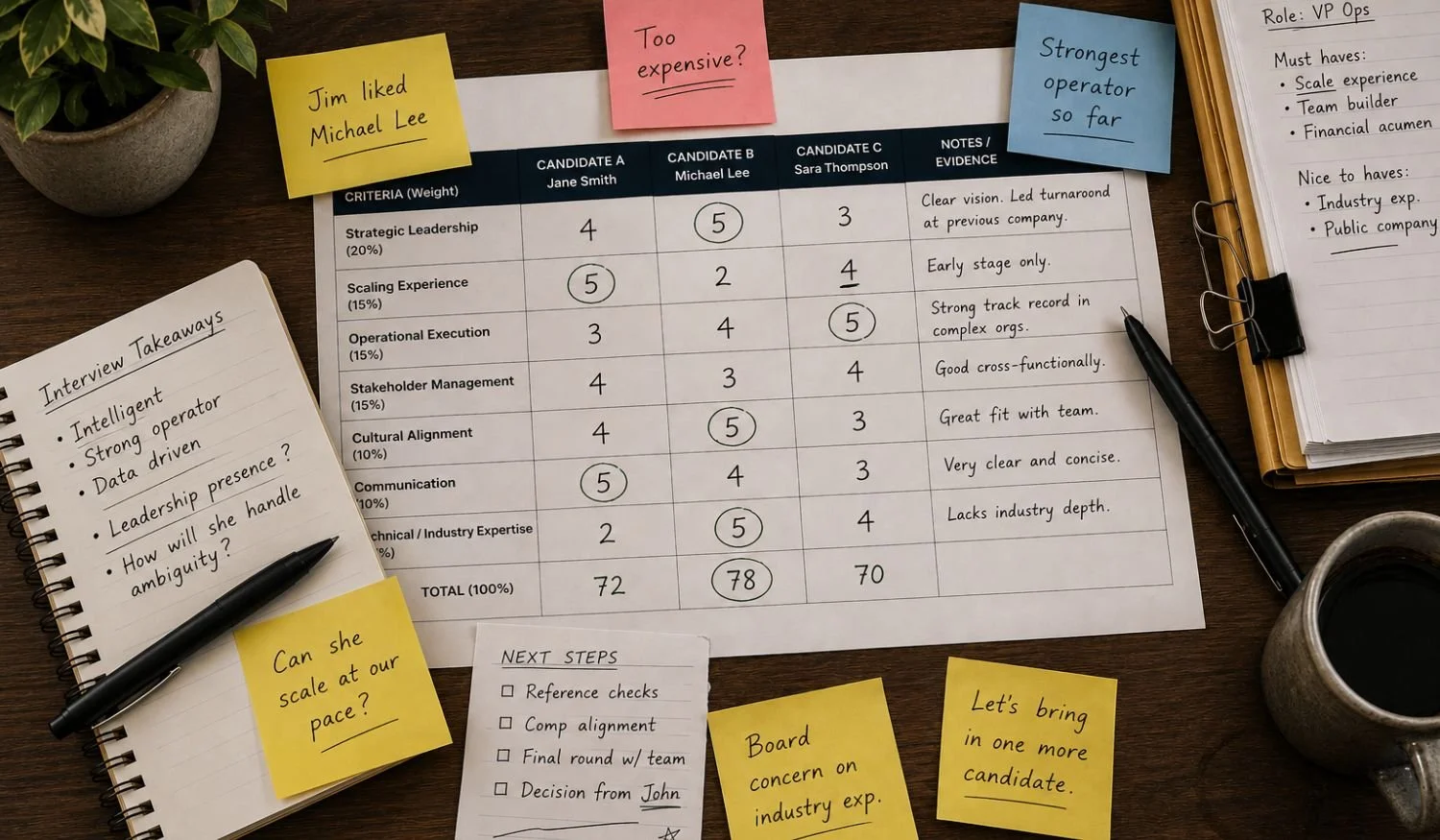
Structured scoring systems, where candidates are assessed on the same criteria by the same rubric with trained interviewers, are more predictive of job performance than any other common hiring method. This doesn't have to be complex. It does have to be consistent.
Define the competencies you're evaluating before interviews begin, not during debrief. Build scorecards. Agree on how feedback will be gathered and when. The discipline of doing this upfront pays back in decision quality and defensibility.
One detail that separates strong hiring teams from inconsistent ones: the debrief sequence.
Before any group discussion happens, each interviewer should share their scores and the specific evidence behind them independently. Not impressions — evidence. What the candidate actually said or did that supported a rating. Once that's on the table, then you discuss.
This prevents the loudest voice in the room from anchoring everyone else's recall.
It keeps the conversation grounded in what happened rather than how people felt. The same discipline applies to gut reactions. If something feels off about a candidate, or unusually strong, that's worth naming. But treat it as a question, not a verdict. What specifically triggered the reaction? Is it relevant to the role? Did others observe it? A gut signal that survives that kind of scrutiny is useful data. One that doesn't probably isn't.
3. Set clear timelines and keep them.
Sixty percent of companies reported increased time-to-hire in 2024. Only one in nine succeeded in reducing it. The data on what extended timelines cost is unambiguous: More than half of candidates lose interest in companies that take longer than two weeks to respond, and a third say they feel ghosted after just one week of no communication.
Candidates read your process timeline as a reflection of your organizational culture. A slow, opaque process signals slow, opaque decision-making. A process that moves with clarity and communicates at each step says something different about how you operate.
One process failure we see repeatedly at the leadership level isn't lack of effort. It's too many voices added too late. A third stakeholder gets looped in after round two. A board member wants to meet the finalist. Suddenly, you have five people with five different mental pictures of the role, and no shared rubric to compare notes. Organizations often mistake broader participation for better decision-making. In practice it tends to produce slower timelines, diluted accountability, and conflicting feedback that's nearly impossible to reconcile.
As Ascentria Co-founder Seann Richardson likes to say: "More consensus doesn't mean a better hire. It usually means a longer process and a mushier outcome."
4. Know what you're actually looking for.
One of the most common hiring mistakes at the leadership level is treating a job description as a checklist rather than a profile. The result is a search for someone who ticks every box, which often means overlooking someone who could be genuinely excellent — and settling for a longer search instead.
We wrote about this directly in a recent post on "almost perfect" candidates — the idea that the best hire is often the one who doesn't match the template but fits the actual need. A well-designed process creates space for that kind of evaluation. A checklist-driven one doesn't.
5. Evaluate for what you can't train.
Technical skills can be learned. Industry knowledge transfers. But the things that predict long-term performance, including adaptability, coachability, how someone responds under pressure, and whether they take ownership or deflect, are harder to assess and harder to develop.
A good process builds in deliberate evaluation of these qualities. That might mean structured behavioral questions. It might mean a working session or case study for senior roles. It might mean a reference strategy designed to surface the things that don't come up in an interview — or that get obscured by a polished AI-assisted résumé. Whatever the approach, it has to be intentional. Not an afterthought in the final round.
The Connection to "Almost Perfect"
The recent post on almost-perfect candidates argued that what looks like a gap in a candidate's background is often irrelevant to what actually drives performance — and that the pressure to find someone who checks every box leads organizations to overlook people who could be genuinely excellent.
A well-designed process helps you make that distinction more clearly. When you've defined what matters, you can evaluate a candidate against actual requirements — not an imagined ideal. That's how "close enough" becomes a strategic call rather than a compromise.
Process Is Not the Enemy of Good Judgment
The point of a well-built process isn't to replace judgment. It's to give judgment the conditions it needs to be reliable.
The best hiring managers in the best organizations aren't less intuitive. They're more systematic. Their instincts are informed by consistent frameworks, clear criteria, and well-run evaluation processes. That's what lets them make confident calls, especially on non-obvious candidates.
If your process is creating confusion, slowing decisions, or producing inconsistent outcomes, those are symptoms, not inherent features of structure. A good process should do the opposite: create clarity, move faster, and give everyone involved more confidence in the outcome.
If Your Process Isn't Working, Start Here
The companies that consistently make great hires aren't necessarily the ones with the most sophisticated technology or the largest talent teams. They're the ones who've done the unglamorous work of aligning stakeholders, defining criteria, training interviewers, and communicating with candidates like they mean it.
If you're not sure where your process stands, a few honest questions can clarify things quickly:
Do your interviewers know what they're evaluating before they walk into the room?
Is every candidate being assessed against the same criteria?
Are your stakeholders aligned on what success looks like in this role before the search begins?
What does your response time to candidates communicate about how you operate?
If the answers are unclear or inconsistent across your team, that's the starting point.
Getting the process right doesn't guarantee a perfect hire. Nothing does. But it dramatically improves your odds, protects your organization from avoidable costs, and signals to candidates that you're an employer worth their time.
That's what good looks like.
Ascentria Search Partners works with HR leaders, CEOs, and executive teams to design and execute searches that find the right leader — not just an available one. If your hiring process needs a second look, we'd welcome the conversation.
